
Set up the web library for signals (Premium)
Guide for Connect Premium customers
Behavior signals are events that are typically important to any business, regardless of the industry. You can configure the Connect library to generate them while visitors are interacting with your website.
Not sure what your license type is?
You can quickly check what type of Connect license your company is using. Log in to your Connect account and see the label on the home screen.
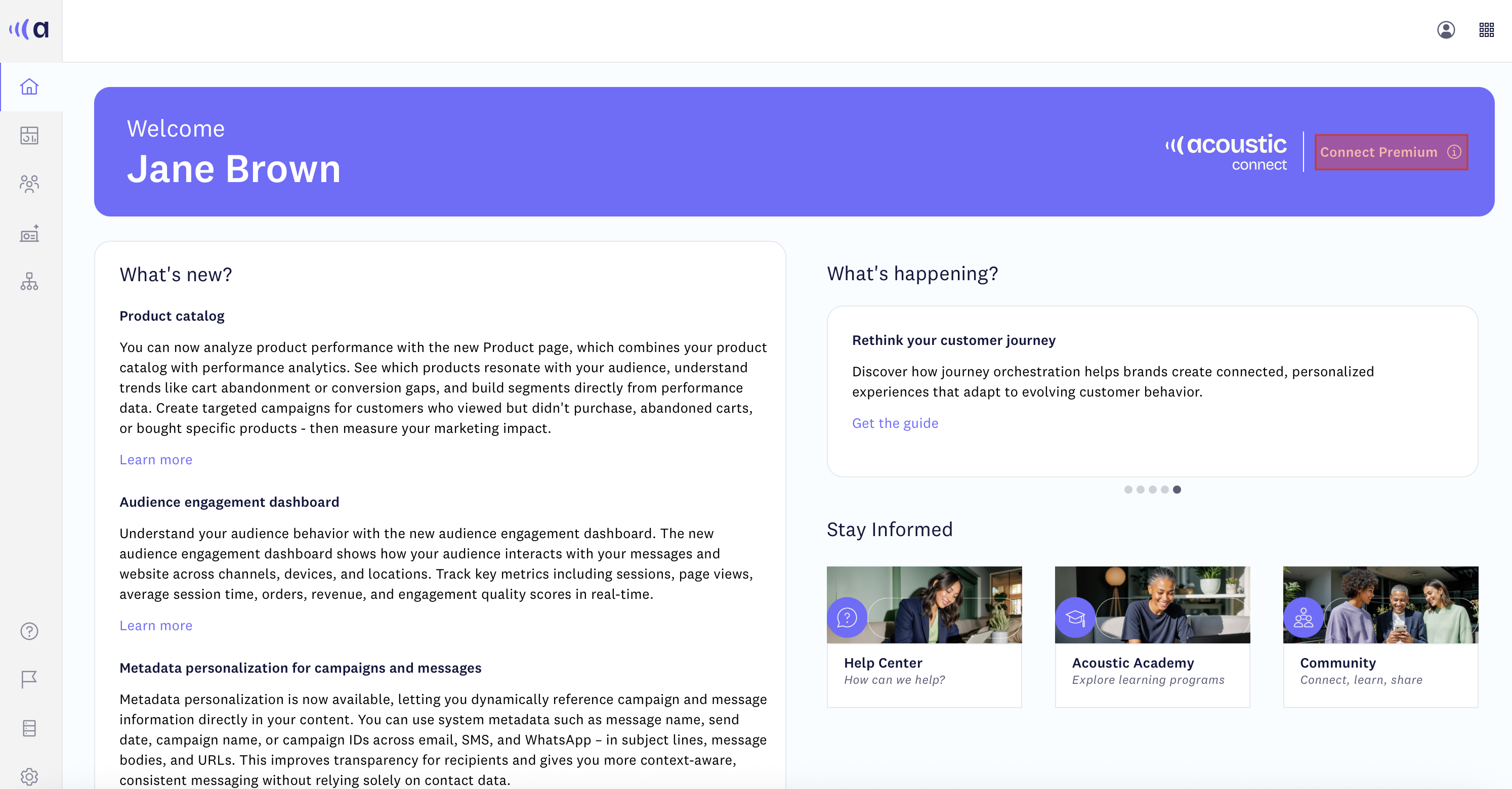
Sample Connect Premium subscription
If your subscription is Pro, see Set up the web library for signals(Pro). If your subscription is Ultimate, see Set up the web library for signals (Ultimate). If it's Premium, continue reading.
Behavioral signals you send from your website
With a Connect Premium subscription, you can send these signals from your website and map them to contacts in your audience. You send each one with a TLT.logSignal() call, as described below.
- Logged in – Captures authentication events as a visitor logs in
- Account registered – Captures new account/registration completions
- Identification (legacy) – Captures visitor emails or contact IDs as they browse your website; superseded by audience‑object mapping for new implementations, but still supported
- On-site search – Captures search queries and results a visitor interacts with
- Error - Captures errors that lead users away from the happy path. Focus on payment, promo code, and account registration errors that result in lost sales opportunities.
- Rich media interaction – Captures engagement with video, audio, or other embedded media
- Product configuration – Captures product option/configuration selections (size, color, and similar variants) before purchase
- Product view – Captures when a visitor views a product detail page
- Remove-from-cart – Captures when a user removes products from their shopping cart
- Add-to-cart – Captures when a user adds products, services or offerings to their shopping cart
- Page view – Captures page navigation events as a visitor moves through your site
Note:
pageView is also generated automatically from SDK screen-view activity, independent of the explicit implementation described below — see Page view signals for how it works and how it interacts with your own pageView signals.
- Order – Captures completed orders with total amounts and detailed product breakdowns
- Wishlist item added – Captures when a customer adds a product to a wishlist or saved-items list
- Wishlist item removed – Captures when a customer removes a product from a wishlist or saved-items list
Browse abandonment and Cart abandonment are also available, but are inferred signals with no library call to implement
Signals Connect records for youConnect also records message signals on its own, such as email opens and mobile push deliveries. You don't send these from your website. To use them in segments, see Segment by customer actions.
Important considerations
The signals are designed to capture all necessary details for each use case. However, some fields may not be available or applicable to your business:
-
No pricing information - If your business doesn't display prices (insurance quotes, B2B requests), use placeholder values for required price fields in signals.
-
Third-party checkout - If users complete checkout on a third-party platform where you cannot install the Connect library, collect order data on your confirmation page or via backend integration. Typical examples include payment processors and ticket-selling platforms.
-
Identification timing - Ensure user identifiers (email, customer ID) are accessible when a signal fires. Consider surfacing identifiers in your data layer once users log in.
Understanding Premium configuration
To implement behavior signals, you must first add the Connect library to your web application and initialize it using TLT.initPremium(), a function added in version 6.4.189. This function automatically applies settings optimized for Premium-tier capabilities, which include all behavioral signals plus optional features like Ajax monitoring.
ImportantBefore capturing any customer data, work with your Acoustic representative to ensure the SDK is properly configured for your application. This includes:
- Discussing options for deploying and hosting the SDK before production deployment
- Verifying that all necessary data is captured correctly
- Ensuring the SDK is not collecting sensitive information from your pages
Prerequisites
To integrate the Connect library into your app, you need an application key and collector URL. You can generate these credentials yourself in your Connect account. For instructions, see Get an application key for the Connect library.
Instructions
Step A: Install the Connect library
- In your webpage template, add the following code snippets anywhere within the
<head>tag. This ensures they execute as early as possible on page load.
<script src="https://cdn.goacoustic.com/connect/latest/acoconnect.min.js"></script>
<script>
(function () {
    if (window.TLT) {
        TLT.initPremium({
            appKey: "APP_KEY",        // Replace with your application key
            postUrl: "COLLECTOR_URL", // Replace with your collector URL
            callback: initLogSignal
        });

        function initLogSignal() {
            // Connect library is ready
            // Add your signal implementation code here
            console.log("Connect Premium SDK initialized");
        }
    } else {
        console.error("Connect library failed to load");
    }
}());
</script>- Replace
APP_KEYandCOLLECTOR_URLwith your Connect credentials. - Push the changes to the server.
Important notes:
- Script order matters: The Connect library file must load before the initialization code. Do not change the order of the two
<script>tags. - Callback timing: The
initLogSignalcallback function executes only when the Connect library is fully initialized and ready. All signal implementation code must be placed inside this callback to ensure the library is ready before signals are sent. - Error handling: The code checks if
TLTexists before calling to prevent errors if the library fails to load. - Version pinning: You can replace
latestin the CDN URL with a specific version number for production deployments to ensure consistency. Version 6.4.189 or later is required forinitPremium()support.
Step B: Customize the SDK (optional)
The initPremium() function accepts additional optional parameters:
TLT.initPremium({
    appKey: "APP_KEY",
    postUrl: "COLLECTOR_URL",
    addPako: true,                // Enable compression (default: true)
    addAjaxListener: false,       // Track AJAX calls (default: false)
    addRestartTLTforSPA: true,    // SPA support (default: true)
    remoteConfigUrl: undefined,   // Remote config URL (optional)
    callback: initLogSignal
});
For more complex customization needs (such as disabling specific modules or modifying default behaviors), you can pass a custom configuration object:
function configureSDK() {
    // Get the default config from the SDK core
    const config = window.TLT.getDefaultConfig();

    // Modify the default config
    config.core.buildNote = "Connect SDK with custom config";
    config.core.modules.dataLayer.enabled = false;

    return config;
}

if (window.TLT) {
    TLT.initPremium({
        appKey: "APP_KEY",
        postUrl: "COLLECTOR_URL",
        newConfig: configureSDK(),    // Custom SDK configuration
        addAjaxListener: true,        // Enable optional Ajax Listener
        callback: initLogSignal
    });
}

function initLogSignal() {
    // Add your signal implementation code here
    console.log("Connect Premium SDK initialized with custom config");
}
Step C: Enable behavior signals
Now that the library is installed and initialized, you can configure the behavior signals. All signal implementation code must be placed inside the initLogSignal callback function to ensure the library is ready.
See Behavior signal implementation in the Connect Web SDK for detailed implementation instructions.
Each signal page provides required and optional fields, code examples and implementation guidance.
Example signal implementation:
function initLogSignal() {
    console.log("Connect Premium SDK initialized");

    // Example: Track add-to-cart button clicks
    document.querySelectorAll('.add-to-cart-button').forEach(function(button) {
        button.addEventListener('click', function(e) {
            // Extract product data and log signal
            TLT.logSignal({
                signalType: "addToCart",
                name: "Product added to cart",
                category: "Behavior",
                // ... additional signal data
            });
        });
    });
}
Migrating from Acoustic Campaign?You must replace the Silverpop Web Tracking pixel with the new, flexible logSignal-based tracking method in Acoustic Connect.
Step D: Verify signal capture
To confirm that signals are implemented correctly and data is flowing:
- Click around on your website to trigger the signals you have activated. To see signals on a contact, each signal needs a contact identifier in its
audienceobject (or, if you use the legacy method, an identification signal must fire first). - Log in to your Acoustic Connect subscription.
- Go to Audience > Contacts.
- On the All contacts tab, select the contact you used for testing the signal.
- In the activity feed, view the activity associated with the selected contact.
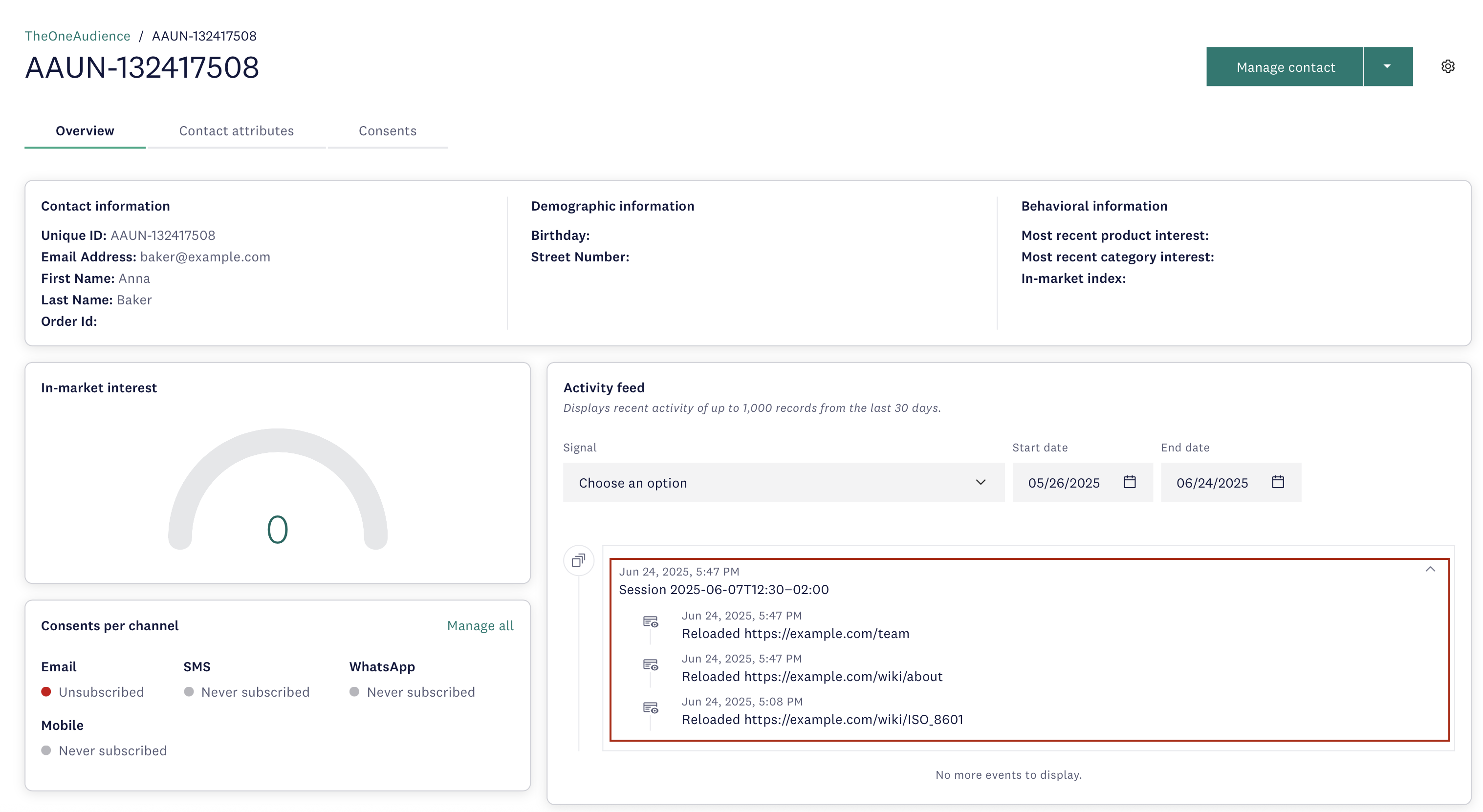
What to look for:
As you expand a user session, you can see the 5 most recent signals of each type associated with it. You should see:
- An event for each signal you implemented, with its details (for example, product details for add-to-cart, order totals for order)
- Session groupings (signals from the same visit are grouped together)
NoteThe activity feed displays the last 1000 signals or signals from the last 30 days. In some cases, newly added signals may not be immediately visible.
Alternative verification method:
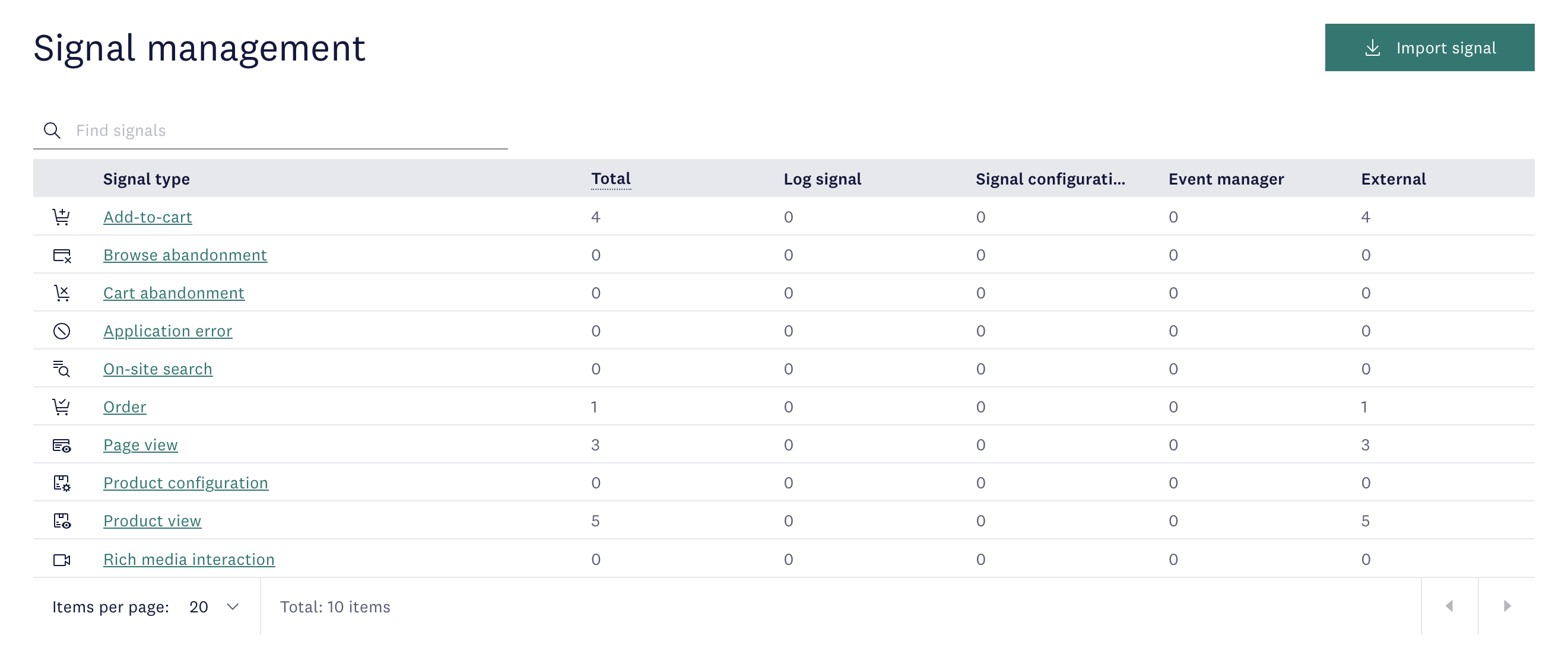
To view all signals without limitations, navigate to Behavior studio > Signal management and click on a signal type.
Troubleshooting
Signals not appearing in Connect?
- Verify all required fields are populated (see individual signal documentation)
- Check browser console for JavaScript errors
- Confirm application key and collector URL are correct
- Check that each signal includes a contact identifier in its
audienceobject (or, with the legacy method, that an identification signal fired before other behavioral signals) - Verify signals are being sent inside the callback function - signals sent before initialization completes will fail silently
Callback function not executing?
- Verify the Connect library loaded successfully (check browser Network tab)
- Check for JavaScript errors before the
initPremium()call - Confirm callback function is defined before being passed to
initPremium() - Check the browser console for the "Connect library failed to load" error message
"initPremium is not a function" error?
- Verify you're using version 6.4.189 or later of the Connect library
- Check that the library file loaded successfully (no 404 errors in Network tab)
- Confirm the script URL is correct:
https://cdn.goacoustic.com/connect/latest/acoconnect.min.js
Signals appearing with missing data?
- Review required vs optional fields for each signal type
- Check that data extraction logic matches your site's DOM structure
- Verify timing - some data may not be available when signal fires
- Use
console.log()to debug extracted values before sending signals
Library file not loading?
- Check that the CDN URL is accessible from your network
- Verify there are no content security policy (CSP) restrictions blocking the script
- Confirm the script tag is in the
<head>section and loads before the initialization code - Try accessing the CDN URL directly in your browser to confirm it's reachable
Maintenance note
As your website receives updates or gets redesigned, these changes may affect signal configuration. Include signal verification in your regular quality assurance routine to ensure:
- Selectors still match updated DOM structure
- Data extraction logic captures correct values
- Required fields remain populated
- Signals fire at appropriate times in user flows
Next steps
Now that your signals are capturing data, consider the following steps:
- Create segments based on behavioral data
- Set up automated campaigns triggered by signals
- Monitor signal volume in Signal management
- Review the activity feed regularly to understand customer behavior patterns
Related pages
Integrate the Connect SDK into your web application (Premium)
Updated 5 days ago